10 Standard Candles
Recall the relation between flux and luminosity \[ f = \frac{L}{4\pi d_{L}^{2}} \] It follows directly from this that if one knew the luminosity of an object, then a measurement of the flux would give you the luminosity distance. Or if you had a class of objects with the same (possibly unknown) luminosity, then you get relative distances \[ \frac{f_{1}}{f_{2}} = \frac{d_{L,1}^{2}}{d_{L,2}^{2}} \]And given luminosity distance measurements, one can infer cosmological parameters.
10.1 Type 1a SNe
Type 1a SNe are probably the best known standard candles, especially in the context of dark energy where they led to the discovery of dark energy in 1998 and the 2011 Nobel Prize. These are the thermonuclear explosion of a carbon-oxygen white dwarf accreting mass from a companion star as it approaches its Chandrasekhar mass. The relative simplicity of this system means that these have very similar luminosities and are excellent candidates for standard candles. Futhermore, since their peak luminosity can equal or exceed the light of an entire galaxy, they can be seen to very high redshifts.
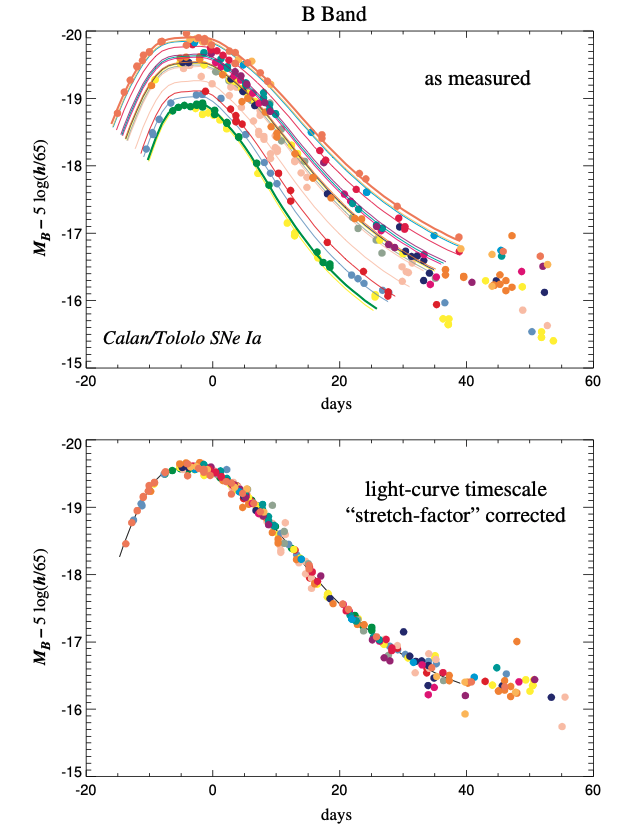
However, SNe-1a are not perfect standard candles and much work has gone into standardizing them. The figure below (taken from the Frieman review) shows different light curves and the diversity of SNe on the top panel and a standardized version on the bottom panel, using the light-curve timescale to standardize them.
10.2 Distance Modulus
In astronomy, fluxes are usually measured in terms of apparent magnitudes \[ m = -2.5 \log_{10} \left( \frac{f}{f_\text{ref}} \right) \] while luminosities are measured in absolute magnitudes \[ M = -2.5 \log_{10} \left( \frac{L}{L_\text{ref}} \right) \] relative to a reference source. Taking the difference, we find \[ m - M = \mu(z) \equiv 5 \log_{10}\left( \frac{d_{L}}{\text{10 pc}} \right) \] where we have defined the distance modulus and chosen our reference sources such that the distance modulus at 10pc is zero. We can rewrite this as \[ m = \left[ M + 5 \log_{10}\left( \frac{c}{H_{0}} \frac{1}{\text{10 pc}} \right) \right] + 5 \log_{10}(\tilde{d}_{L}) \] where \(\tilde{d}_{L}\) is the luminosity distance measured in units of \(c/H_{0}\). This form emphasizes the fact that SNe measure relative distances with one nuisance parameter that combines the Hubble constant and their absolute luminosity. It is only if one has a absolutely calibrated source that one can measure the Hubble constant.
10.3 Recent Results : DES 5yr
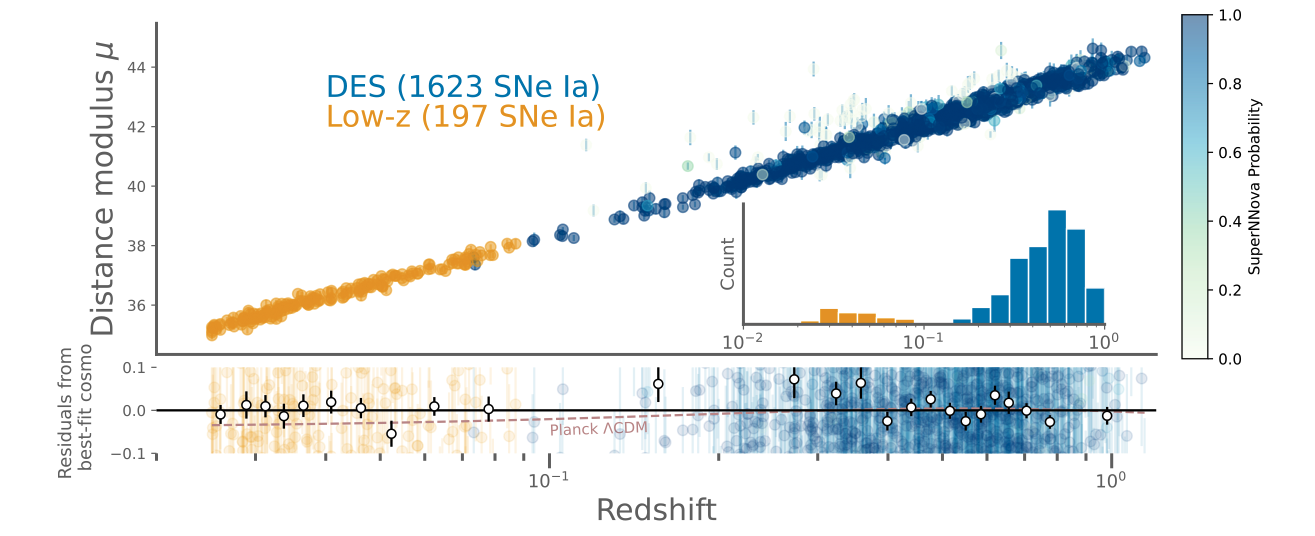
As an example, here are some recent results from the Dark Energy Survey (DES) SNe program (Popovic et al). Start with the Hubble diagram:
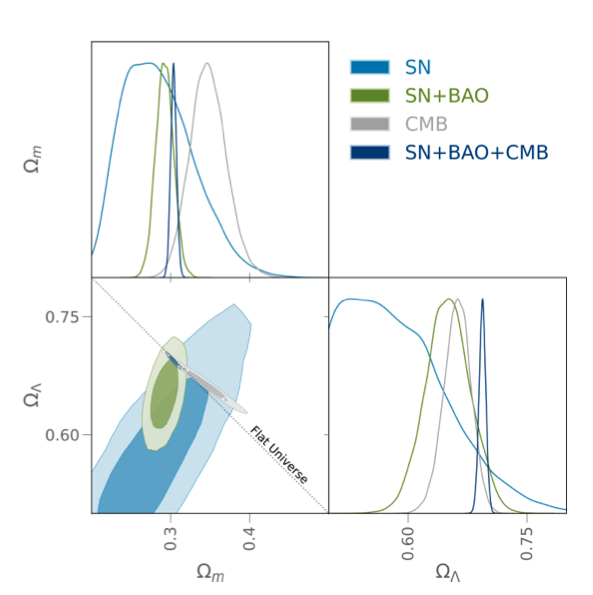
Constraints on a model allowing for a cosmological constant and curvature, and in combination with other data sets
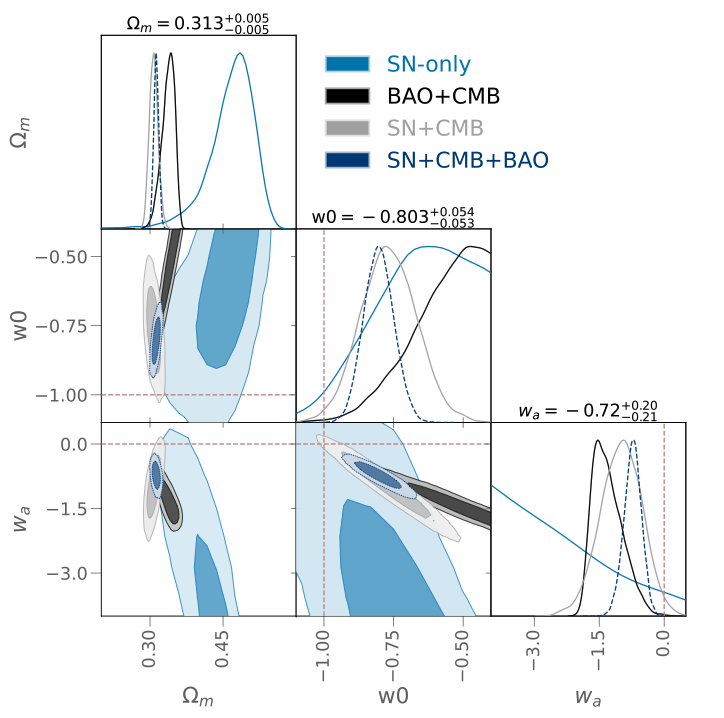
And now looking for dark energy variation with redshift :
10.4 References
This follows Chap 12 in Huterer, and Frieman et al, 2008. The DES results are described here