6 Single Component Universes
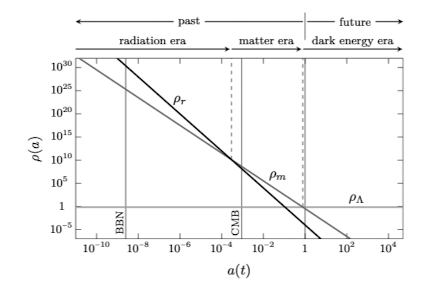
We previously considered the evolution of the density of different components of the Universe. The figure above (from Baumann) shows that, for large parts of the history of the Universe, a single component was dominant. It is therefore quite useful to work through single component Universes.
Note that we treat curvature as one of these components, and so, we will set \(k=0\) in all of what we consider here (the case of curvature is an empty Universe; we do not consider this here, but may in a homework assignment).
There are three components that are largely relevant to modern cosmology today
- matter : \(w=0\)
- radiation : \(w=\frac{1}{3}\)
- cosmological constant : \(w=-1\)
What we will do here is consider a single component with a constant equation of state \(w\neq-1\). The case of \(w=-1\) is special and does not follow from these; we leave this up to the reader. The values for matter and radiation can then be read off these results.
The Friedmann equation reads \[ \left(\frac{\dot{a}}{a}\right)^{2} = H_{0}^{2} a^{-3(1+w)} \] where we use the fact that the density must be the critical density. This gives \[ \frac{\dot{a}}{a} = H_{0} a^{-3(1+w)/2} \] or \[ \frac{da}{a^{-1/2-3w/2}} = H_{0} dt \] Integrating, we get \[ t = \frac{1}{H_{0}} \frac{2}{3(1+w)} a^{3(1+w)/2} \] or \[ a(t) = \left( \frac{t}{t_{0}} \right)^{2/(3(1+w))} \] It follows from this that the age of the Universe is \[ t_{0} = \frac{1}{H_{0}} \frac{2}{3(1+w)} \] We can also calculate the comoving distance \(\chi(z)\) \[ \chi = c \int_{0}^{z} \frac{1}{H(z)} \, dz = \frac{c}{H_{0}} \int_{0}^{z} \frac{dz}{(1+z)^{3(1+w)/2}} \] which gives \[ \chi(z) = \frac{c}{H_{0}} \frac{2}{1+3w} \left[ 1 - \frac{1}{(1+z)^{(1+3w)/2}} \right] \] The particle horizon is (how far back/out we can see) \[ \chi _\text{part} = \frac{c}{H_{0}} \frac{2}{1+3w} \]